Powershell Payload Response
This Playbook is part of the Malware Lateral Movement Assessment and Response Pack.#
Supported versions
Available on Cortex XSOAR (versions 6.0.0 and later) and Cortex XSIAM.
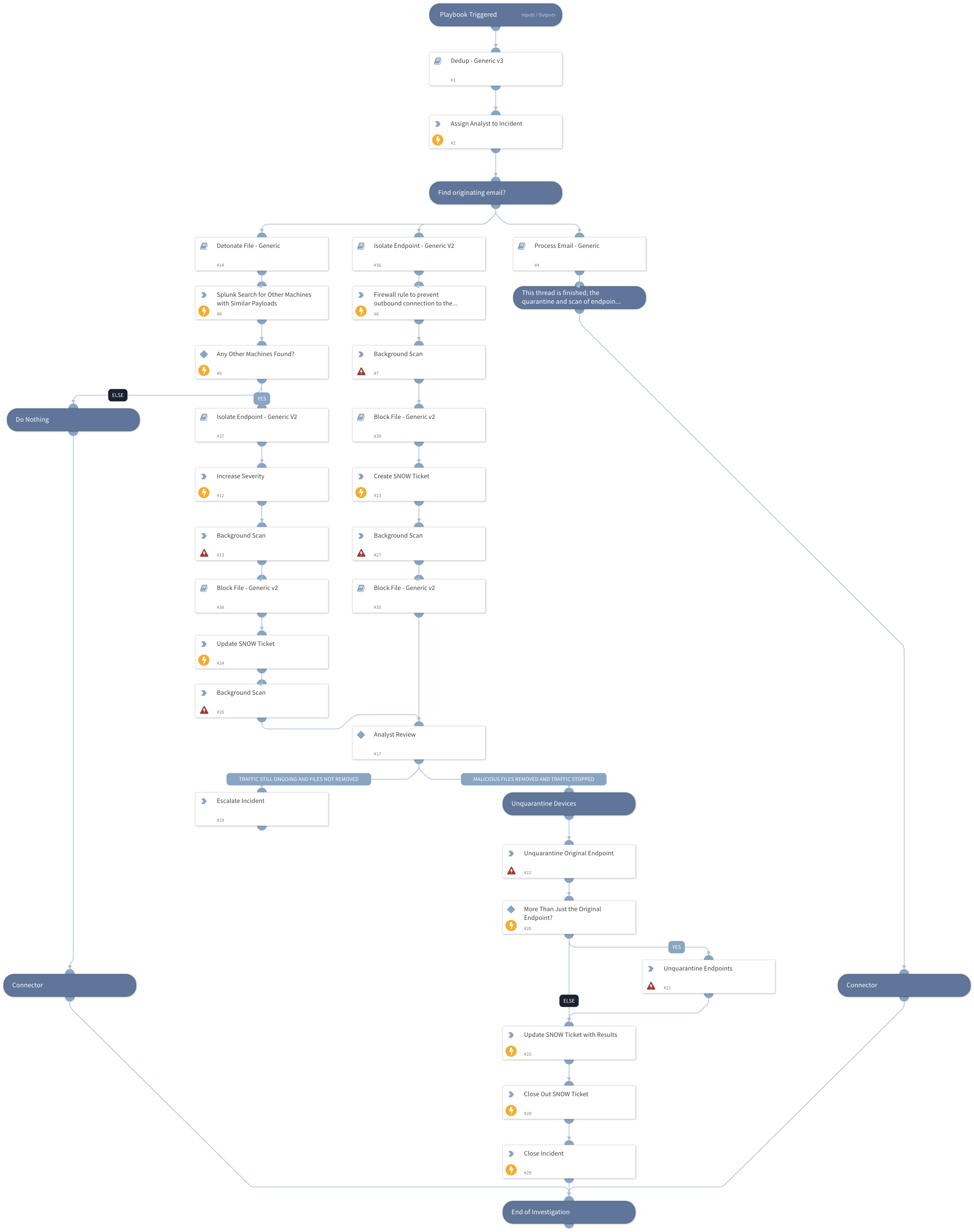
The Powershell Payload Response playbook is designed to be used when file payload executions are detected from an endpoint machines Powershell and begins the remediation process.
Dependencies#
This playbook uses the following sub-playbooks, integrations, and scripts.
Sub-playbooks#
- Process Email - Generic
- Isolate Endpoint - Generic V2
- Block File - Generic v2
- Dedup - Generic v3
- Detonate File - Generic
Integrations#
- Carbon Black Defense
- Carbon Black Enterprise EDR
- ServiceNow v2
- SplunkPy
Scripts#
- AssignAnalystToIncident
- IncreaseIncidentSeverity
Commands#
- cb-eedr-device-background-scan
- splunk-search
- closeInvestigation
- cbd-create-policy
- servicenow-update-ticket
- cb-eedr-device-unquarantine
- servicenow-create-ticket
Playbook Inputs#
| Name | Description | Default Value | Required |
|---|---|---|---|
| Endpoint ID | ID of the endpoint in question. | ${incident.endpointid} | Optional |
| Hostname | Hostname of the endpoint in question. | ${incident.hostname} | Optional |
| Email attachment. | ${incident.email} | Optional | |
| File | Payload file that was executed. | ${File} | Optional |
| File Path | File Path of the Executed Payload. | ${incident.filepath} | Optional |
Playbook Outputs#
There are no outputs for this playbook.
Playbook Image#